
Écrit par Kosisochukwu Charity Ani
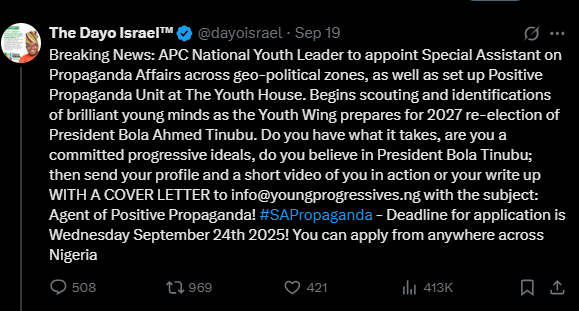
In a move that raises new concerns about the spread of election misinformation, the youth wing of the All Progressives Congress (APC) has reportedly launched a recruitment campaign for what it calls "special propaganda assistants."
This initiative, launched by the APC youth leader, Dayo Israel, marks a new, more aggressive approach to the political campaign for the re-election of President Bola Tinubu.
The open call and explicit use of the term "propaganda" raise serious questions about the party's communication strategy and its potential to normalize the spread of false information.
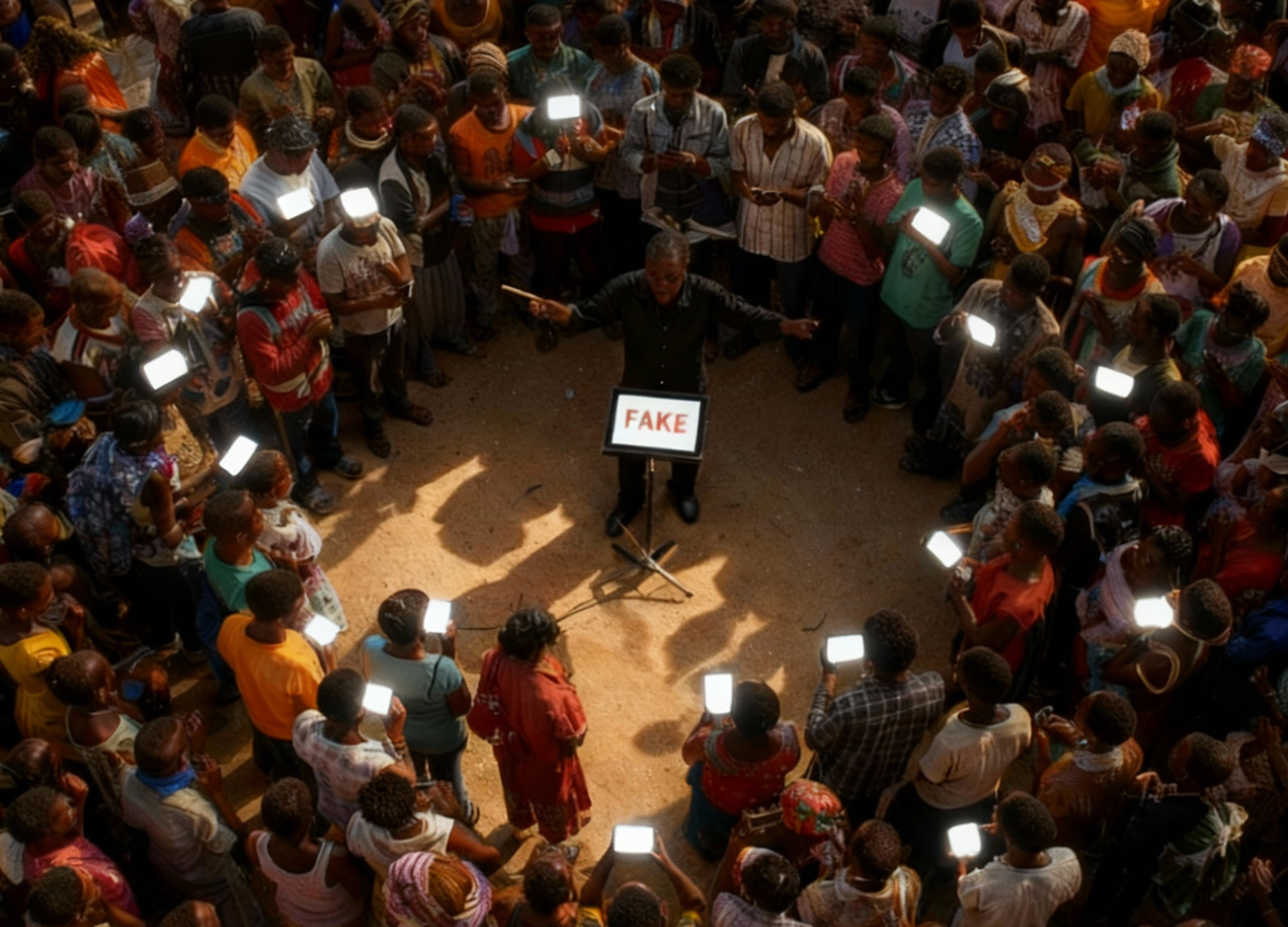
This reflects a broader trend in Africa, where political parties are putting in place sophisticated digital operations to shape discourse and influence public opinion, often blurring the line between legitimate political messages and the well-coordinated dissemination of disinformation.
There is no such thing as "positive propaganda": an expert warns against the trivialization of disinformation
Akintunde Babatunde, a media expert and executive director of the Centre for Journalism and Development (CJID), has issued a stark warning against the trivialization of what some call "positive propaganda" in Nigerian politics. He argues that the use of this term is a "tragedy for democracy" because it fundamentally distorts the true nature of propaganda.
According to Babatunde, “propaganda is not simply promotion, but a centuries-old tool of manipulation, dating back to the Congregation for the Propagation of the Faith in 1622.” Given the widespread resentment among young people over unemployment and governance failures, he further warned that promoting propaganda as a career path sends a dangerous signal. Beyond its effects at the national level, this practice could also damage Nigeria’s democratic image globally. For democracy to survive, young people must reject manipulation and become champions of civic renewal, he cautioned.
In this opinion piece, which he published on his official account X, he highlights the many dangers associated with the institutionalization of propaganda, arguing that this practice pushes young Nigerians to become mere "amplifiers of political discourse" rather than empowering them to be agents of truth and responsibility.
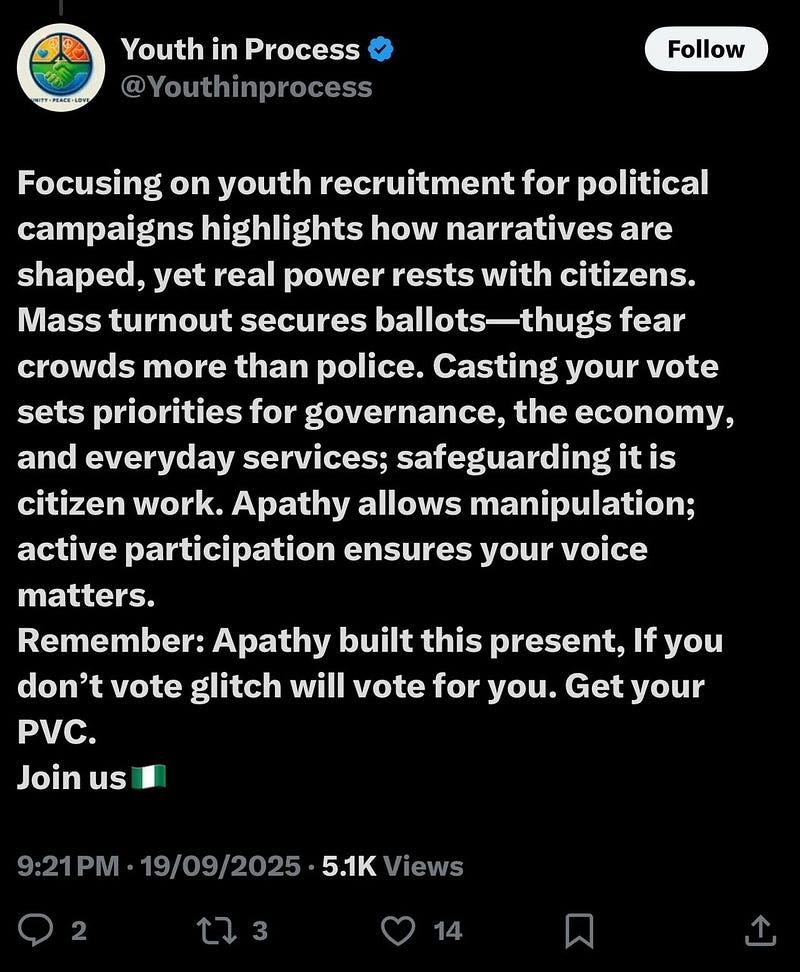
Youth in Process, a youth-led movement aiming to improve the electoral process and awareness, commented on the post urging young Nigerians to see this as a wake-up call to realize the power they hold in elections and use it wisely.
A pan-African problem: coordinated disinformation during elections
This official recruitment campaign reflects a much larger problem affecting the entire continent. As the African Centre for Strategic Studies points out, there is a “ close link between the extent of disinformation and instability .” The use of widespread internet access for military purposes has had tangible and real consequences, ranging from fueling deadly violence and validating military coups to silencing civil society.
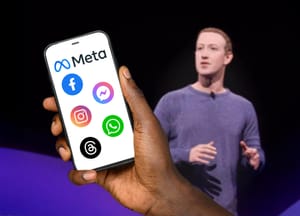
With over 400 million active social media users and 600 million internet users across the continent, Africans are among the world's largest consumers of news on social media platforms. This reliance makes them particularly vulnerable to disinformation, as evidenced by reports indicating that Nigeria and Kenya are the countries most concerned about misleading information.
The data shows that West Africa is the epicenter, with 72 disinformation campaigns targeting 13 countries. It is followed by East Africa, with 33 campaigns targeting 8 countries. Southern Africa has 25 campaigns targeting 8 countries. Central Africa has 21 campaigns targeting 4 countries. North Africa has 15 campaigns targeting 5 countries.
The sheer scale of these campaigns raises a fundamental question: who is funding this disinformation and who is profiting from it?
A flurry of appointments: Governors are turning political favoritism into a booming industry
The APC's initiative also reflects a broader trend where political patronage has found a new outlet in the digital sphere. Although this is the first open call for applications for "propaganda specialists," loyalists of the regime have consistently been rewarded, a career path that now often culminates in a public appointment.
In Kano State, Governor Abba Yusuf made headlines by appointing an extraordinary number of media aides. In just one month, he appointed 94 social media influencers . This appointment followed a previous wave in which he had already appointed 44 "special reporters." His administration now has a total of 138 special reporters , a number that raises questions about the scope and necessity of their roles.
Similarly, Governor Ahmadu Fintiri of Adamawa State has not hesitated to expand his media team. He has reportedly appointed 47 media advisors to his cabinet, joining the ranks of governors who prioritize a strong media presence.
Most recently, Governor Eno of Akwa Ibom State appointed 368 people as personal assistants, seemingly part of a growing trend among governors to create large numbers of new positions for their political loyalists. A closer look at recent appointments reveals a pattern of mass hiring, particularly for media positions.
These appointments and initiatives call for a close examination of the specific roles of these propaganda specialists , the potential safeguards against disinformation, and the ethical implications of a political party that openly adopts propaganda as a campaign tool.
The creation of an official “propaganda” unit, tasked with managing public perception, demands immediate attention from election observers and civil society. This development could test the resilience of Nigerian democracy in the face of concerted disinformation campaigns, highlighting the urgent need for rigorous fact-checking, digital literacy, and platform accountability in the lead-up to a crucial election.