

Rumors that Oseloka Obi, son of former presidential candidate Peter Obi, was gay began spreading widely on Nigerian social media in August 2025. The photos, widely shared on Facebook and Twitter, were quickly reinterpreted as evidence of a scandal, despite the lack of supporting evidence. These allegations, spread across partisan networks, popular blogs, and amplified by social media users, became the latest example of how electoral disinformation is being weaponized in Nigerian politics.
The allegations that Oseloka was gay were not supported by any evidence. Yet, within hours, the story became a trending topic on TikTok, spread on WhatsApp, and was amplified by verified Twitter accounts known for posting partisan content.
This happened in the run-up to the primary elections; it was not a coincidence, but a well-coordinated campaign of electoral disinformation. It was classic disinformation, an attack not only on an individual, but also on the credibility of a political figure.
A photo used as a weapon
The controversy began when photos surfaced online showing Oseloka with a British-Nigerian acquaintance in London. These images, which were snapshots of him posing with another person, were reinterpreted on social media as evidence of a "gay scandal."
Twitter user Sarki, also known as the “Voice of the North,” shared the photo with the caption, “Peter Obi’s son and his partner are enjoying life, but his supporters will turn a blind eye.” Well, congratulations to the soon-to-be couple. The tweet, which implied that Oseloka Obi and the other person in the photo were a couple, indirectly implying that he was gay, garnered 1.7 million views, 11,000 likes, 1,900 comments, and 1,500 retweets. Another X user, Thelastdon, also left a comment asking the author of the post to “make sure the rest of the north sees this,” a wish he granted by replying, “You can count on it.”
Within hours, dozens of blogs and social media users recycled the images, all amplifying the claim without providing any evidence.
This is a classic case of decontextualization, where opponents take a banal element and reframe it to fit a scandalous narrative. This type of practice thrives because people are predisposed to believe the worst about their political opponents.
A culture of smear campaigns
The use of sexuality as a weapon is nothing new in Nigerian politics. In a conservative society where LGBTQ+ rights remain controversial, rumors of homosexuality can have devastating political consequences.
During the 2019 elections, a widely shared claim on Facebook and Twitter, subsequently picked up in blog posts and even reported by two major Nigerian newspapers, claimed that a prominent LGBT rights organization had endorsed opposition presidential candidate Atiku Abubakar ahead of the February elections. However, there is no evidence to support this claim, or even to prove that the organization in question actually exists.
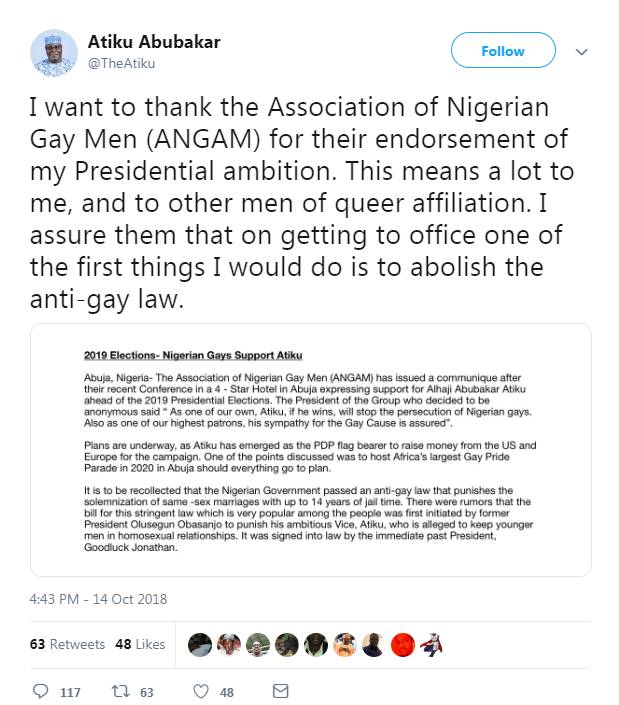
This message, published by a fake account created in the name of the opposition leader, generated significant interest. This well-coordinated smear campaign was later debunked, but the people who launched it did so with the aim of ruining the candidate's reputation and dividing his voters, knowing full well that most of his supporters come from northern Nigeria, a predominantly Muslim region.
Homosexual accusations, even when unfounded, are used as smear tactics precisely because they exploit stigma. The point isn't whether people believe them. It's about sowing doubt in voters' minds and forcing candidates onto the defensive.
During the 2023 election, fact-checkers documented similar patterns of rumor spreading. Several candidates were targeted by fabricated videos, including deepfakes showing them supporting unpopular positions. Others were the subject of rumors linked to their families intended to portray them as morally compromised.
Digital Echo Chambers
The speed with which Oseloka's story spread highlights the architecture of Nigeria's disinformation ecosystem.
TikTok and Facebook: Videos with sensational titles have echoed this claim, some recording hundreds of thousands of views in 48 hours.
Blogs and influencers: Dozens of low-quality websites published nearly identical articles, boosting the story's visibility in Google searches.
Twitter/X amplification: Anonymous, partisan accounts pushed hashtags into trending sections, ensuring the rumor entered the mainstream political debate.
This was not a random rumor, but a carefully orchestrated campaign, indicating systematic amplification rather than spontaneous chatter.
The target responds
Breaking his usual silence, Oseloka reportedly issued a rare public statement.
"Because of my father's involvement in Nigerian politics, I have been the subject of persistent curiosity and, at times, malicious obsession. I rarely correct this misinformation, but perhaps it is time I addressed it."
He called the allegations "malicious fabrications" and stressed that the images were innocent snapshots taken with friends.
In a longer message, he added:
“To assume that my life or my choices are somehow political statements is flawed and childish reasoning... They are not revelations. They are simply misrepresentations based on fiction taken from photographs.”
He urged Nigerians to refocus on governance issues: insecurity, economic hardship, healthcare and infrastructure.
Attacking politicians through their children is a time-honored tactic. As the 2025 gubernatorial elections in Anambra State approach, similar rumors have also circulated that the son of the incumbent governor, Chukwuma Soludo, who is seeking a second term, is gay.
By targeting a family member, rumormongers can erode public trust without having to directly invent stories about the candidate himself.
In the case of Peter Obi, Twitter user Sani Suleman Isah tweeted: "Peter Obi spent over 20 years raising Osekolo and still failed, but he wants to solve Nigeria's problems in 4 years..."
Attacking or defaming a political figure through their child is a tried-and-true tactic. It serves as a form of proxy warfare, undermining the candidate's credibility without directly attacking them. The target is not only the individual, but also the family dynamics that influence public perception. This type of targeted rumor not only damages the candidates' personal image but also distorts the broader political debate, creating divisions and even deterring voters from participating in the election.
Recurring disinformation during Nigerian elections
The Oseloka case is emblematic of a broader trend in Nigerian political discourse: the use of disinformation as a weapon to distract voters from crucial issues.
2019 Elections: False information about the health of APC presidential candidates circulated widely. Rumors circulated about the death of President Buhari, and news spread that his clone was running for a second term.
2023 Election: Fact-checkers debunked more than 200 viral misinformation stories, ranging from fake endorsements to doctored videos.
Ongoing: Coordinated rumor campaigns continue to target figures from all major political parties.
A haunted democracy
Civil society groups warn that unless platforms improve their transparency and the government strengthens digital literacy, this cycle will intensify by 2027.
Exploitation of cultural bias: Allegations of homosexuality are used because they resonate in a society where LGBTQ+ issues remain taboo.
Erosion of public trust: When misinformation dominates the discourse, citizens are distracted from evaluating real political debates.
Blurring of the lines between private and public life: politicians' families become the target of political information wars, undermining personal dignity in favor of partisan struggles.
The Oseloka case is just one example of the many challenges facing Nigerian democracy. As misinformation continues to flourish on platforms such as TikTok, Twitter, and Facebook, Nigerian voters must remain vigilant and question the motives behind articles that seem designed to distract from the real issues facing the country.
As Oseloka Obi said, "Nigeria has much bigger problems than idle speculation about the activities of Peter Obi's son."
Écrit par Kosisochukwu Charity Ani