


In Bamako, as in several major cities, military convoys crisscross the streets. Authorities speak of "regained sovereignty" and "securing the territory," projecting an image of control. Yet, in many localities, the feeling of insecurity remains omnipresent.
What once seemed confined to the north of the country is now spreading to the center and west. The security crisis is gaining ground, and armed groups are asserting their influence as far as the Kayes and Nioro regions of the Sahel, where ambushes and kidnappings are increasingly reported. National roads have become zones of uncertainty: between improvised checkpoints, robberies, and isolated attacks, travel is now a gamble.
Fuel, a new silent war
"...the cost of securing it sometimes exceeds that of the fuel itself"
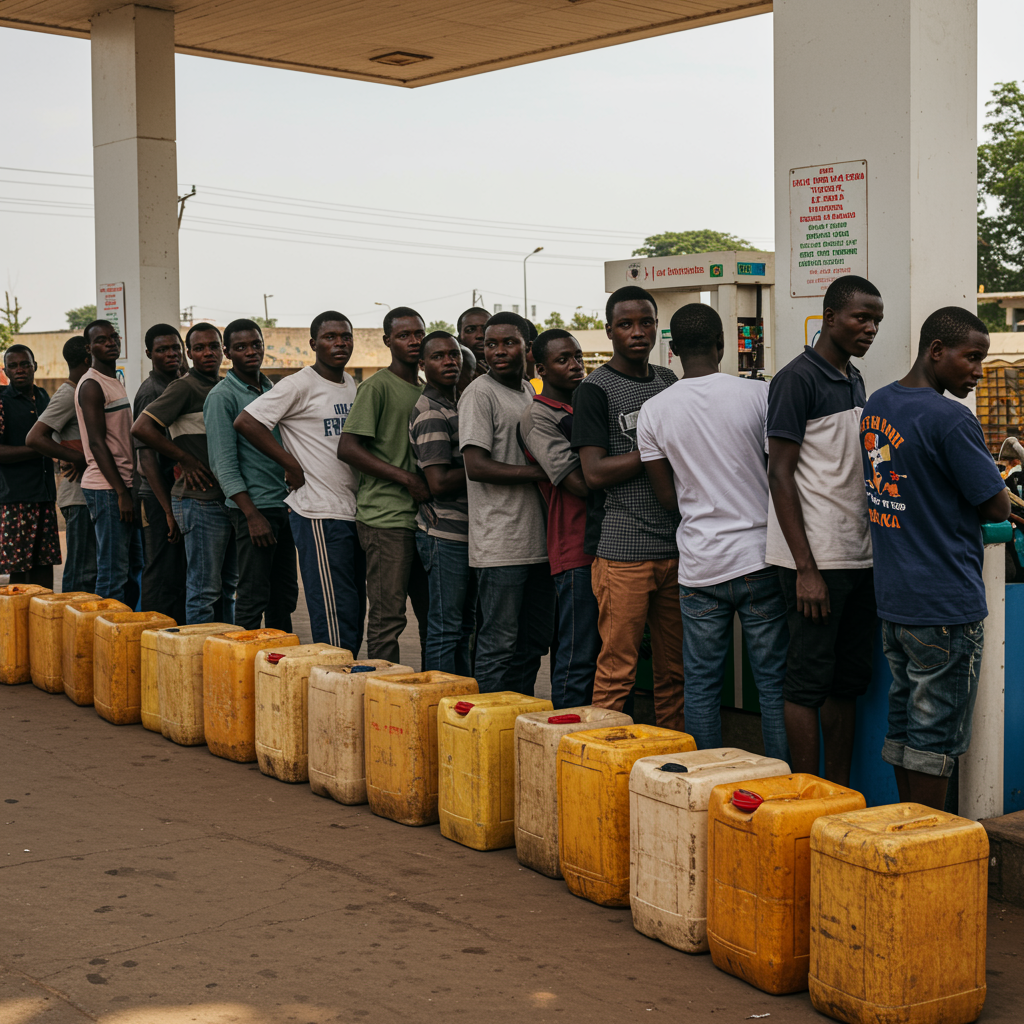
For several days now, following the embargo imposed by the JNIM group on petroleum products, fuel has become a scarce, almost strategic resource. Queues are stretching outside gas stations, prices are soaring on the black market, and many carriers have reduced or even suspended their routes.
In some areas, a liter of gasoline now costs over 3,000 CFA francs , well above the official price. On October 6 and 7, huge crowds formed in front of gas stations, hoping to get a few liters of fuel.
This persistent shortage is weakening the entire national economy. To secure supplies, authorities are resorting to armed escorts for fuel and butane gas tanks. But, as one economist points out, "this solution is not viable: the cost of securing supplies sometimes exceeds that of the fuel itself."
The country is thus experiencing a profound social malaise, fueled by uncertainty and widespread price increases. While the government cites the international situation and the closure of certain corridors, for many Malians, daily life is taking on the appearance of slow asphyxiation.
Electricity, an intermittent luxury
Adding to the security crisis and fuel shortages is now unprecedented energy instability. It should be remembered that Mali's electricity relies almost entirely on thermal generation, making it directly dependent on petroleum products.
In several districts of Bamako, the power sometimes goes out for more than ten hours at a time, plunging entire sections of the city into darkness.
In the capital, residents often only benefit ten hours at a time, plunging entire swathes of the city into darkness.
Faced with this situation, residents are adapting as best they can: some are investing in private generators or solar lamps, while others are resigning themselves to the situation. For many, night is no longer synonymous with rest, but with waiting.
This energy crisis is also affecting the media, businesses and administrative services, paralyzing economic life and fueling a growing feeling of chaos and collective helplessness.
The Escorts of Illusion
In this context, official convoys, triumphant speeches and announcements of stability appear increasingly disconnected from the daily lives of Malians.
Military escorts no longer reassure: they simply remind us of the distance between power and reality. While authorities celebrate sovereignty, citizens escort their survival, between rationing, heat, and uncertainty. Security, fuel, and electricity should be fundamental services.
Today, they have become symbols of inequality: those who can pay get by, while the others sometimes wait in the dark, often in silence.
The promised stability seems like an illusion escorted by weapons and words.
And while the convoys circulate, Malians continue to hope, if not to believe.
Article written by Steve Mvondo