
Women are very often overlooked in anti-disinformation campaigns because they remain invisible. Cultural and religious codes, which act as barriers, leave them on the sidelines. Some women are challenging this situation and trying to change things.
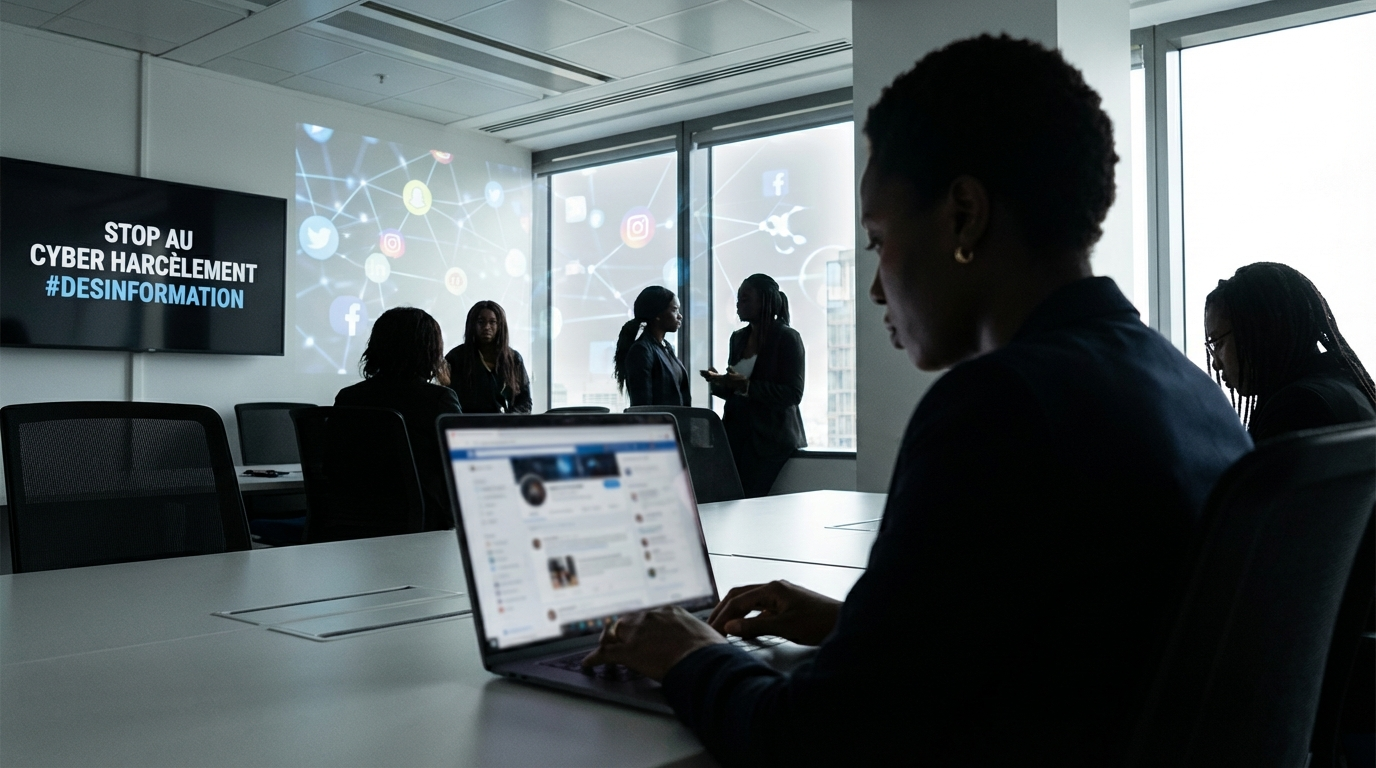
Between gendered propaganda, disinformation, and hate speech, African social media is increasingly becoming a danger zone for women and girls. The tactic is insidious, even perverse. The attacks, disguised as humor or opinion, directly target women who try to make their voices heard, whether they are in the public eye or not. Because these women are unwelcome.
Some, like the Senegalese journalist and author Maimouna Hélène Diop, tackle taboo subjects such as reproductive health, gender-based violence, and social injustices. Her colleague Khady Koita is committed to the fight for women's rights. She opposes forced marriages and, more broadly, violence against women. This is also the mission of Malian journalist and activist Aïssatou Sow Sidibe, one of the first to become involved in feminist movements in West Africa.
All these influential women suffer to varying degrees from harassment, insults, and outright attacks: "Every time I speak out on Facebook to denounce an injustice, I receive an avalanche of insulting messages, often related to my gender and not to my arguments," testifies Mariame Bangoura, president of the NGO Fille d'Aujourd'hui, Femmes de Demain (FAFD), an NGO defending the rights of girls and women in Guinea, Bambouguinée.com
 Mohamed Saliou Camara
Sexist disinformation: the importance of editorial independence
To combat the extension, on social media, of the violence suffered daily, these women are mobilizing for the fight against disinformation and the future of independent journalism in Francophone Africa.
No fewer than 17 journalists from Chad, Mali, Burkina Faso, Niger, Ivory Coast, Senegal, Cameroon, Benin, Guinea, the DRC, Burundi, and Togo met last July in Germany, between Hamburg and Berlin. Their objective was to answer numerous questions: How can these methods be adapted to counter local disinformation and strengthen public trust? How can we tell the truth, but also the stories of progress and development, particularly in Africa, beyond the clichés of conflict?
Invited to the offices of the weekly magazine Der Spiegel, they were able to speak with the heads of the fact-checking unit and thus have their positions reinforced. Because, as Mathieu von Rohr, head of the foreign affairs department at Spiegel, emphasized to them, "without editorial independence, it is impossible to guarantee reliable information."
This is notably the role of Africa Check , which calls upon numerous women who fight against disinformation. Reassured by this training, African journalists are even better equipped to spread the word to African youth and raise their awareness of the dangers of social media.